Compassionate, specialized support for individuals living with cognitive decline.
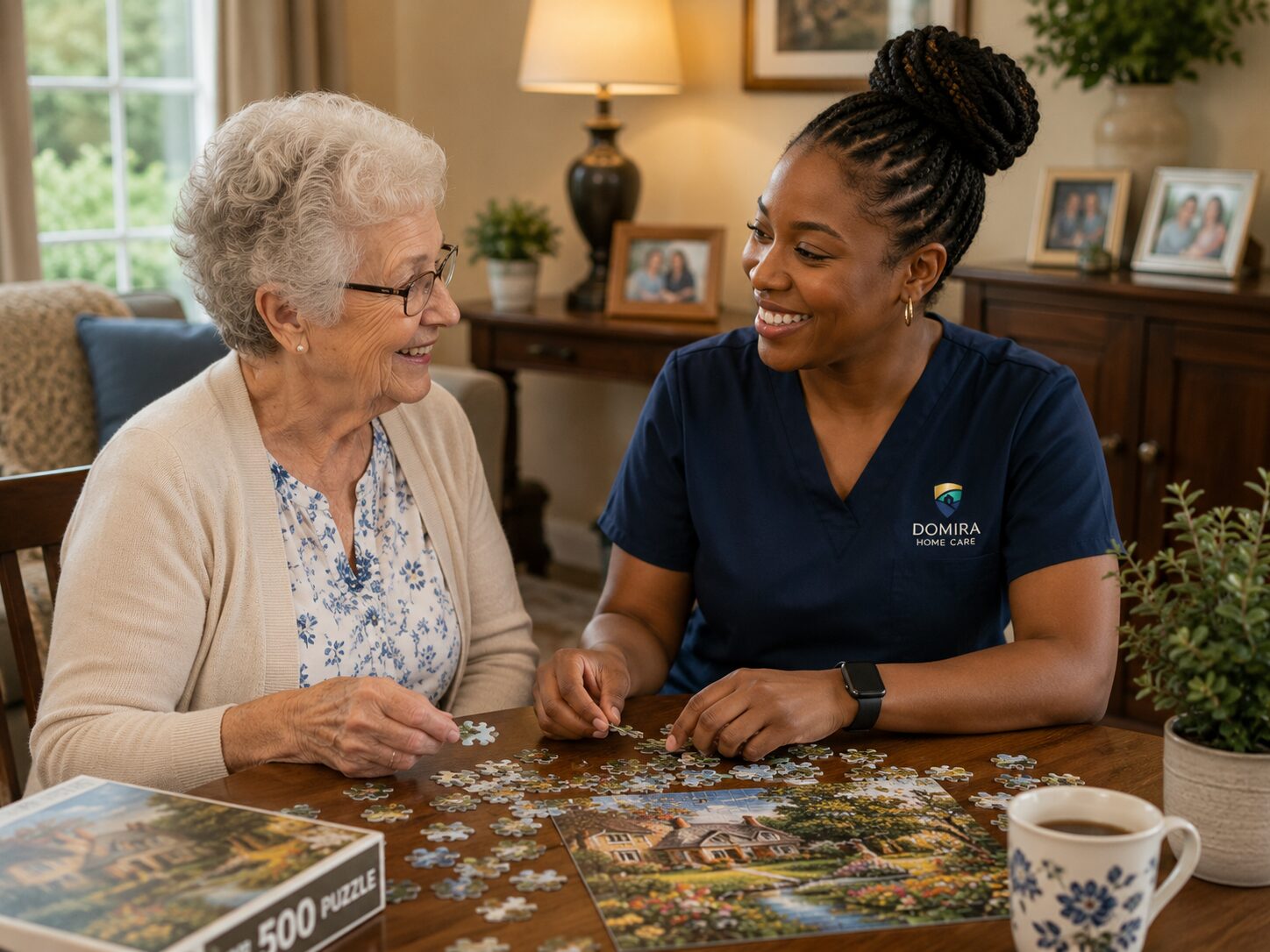
Caring for someone with Alzheimer's disease or another form of dementia is not the same as caring for someone with a physical limitation. Cognitive decline changes behavior, personality, and the ability to process everyday situations. A caregiver who is excellent at personal care may not be equipped to handle sundowning, wandering, or the repetition and confusion that come with dementia.
Domira Home Care provides caregivers who are specifically trained in dementia care. They understand that a person who is agitated is not being difficult. They are frightened, confused, or overstimulated. Our caregivers are trained to respond with patience, redirection, and consistency rather than confrontation or correction.
Dementia is progressive. The level of care needed changes as the condition advances.
Early stage: The individual may forget recent conversations, misplace items, or have difficulty with planning and organization. They can still live independently with light support. A few hours of companion care per week may be enough at this point.
Middle stage: This is typically the longest stage. The individual may struggle with daily tasks, experience confusion about time and place, have personality changes, and begin to need help with bathing, dressing, and toileting. This is when most families contact us. Regular scheduled care, usually 4 to 8 hours per day, provides safety and structure.
Late stage: The individual requires around-the-clock supervision. Communication becomes limited. Assistance is needed for all activities of daily living. Extended hour care or shift-based 24-hour care is typically necessary at this stage.
We help families at every stage. If you are not sure what stage your loved one is in or what level of care they need, we will walk you through it during a free consultation.
If any of these sound familiar, you are not alone. Most families wait too long to get help because they feel they should be able to handle it. There is no shame in asking for support. Contact us at 972-600-2660 or schedule a free consultation.
Dementia care is where the difference between a staffing agency and a care-focused agency becomes most visible. Many agencies send general caregivers who have limited experience with cognitive decline. When the client becomes agitated, confused, or resistive, the caregiver does not know how to respond. The result is frustration on both sides and, in many cases, the family being told their loved one is "too difficult" to care for.
At Domira, we select caregivers for dementia cases based on temperament and training, not just availability. We look for individuals who are naturally patient, calm under pressure, and comfortable with repetition. We train them in validation therapy techniques, redirection strategies, and the behavioral patterns associated with different types and stages of dementia. They understand that a client who asks the same question five times in ten minutes is not being difficult. They are doing the best they can with a brain that is no longer storing new information.
Individuals with dementia rely heavily on routine. When the environment is predictable, anxiety decreases. When things change unexpectedly, whether it is a new caregiver, a different meal, or a change in schedule, confusion and agitation increase.
That is why we build every dementia care plan around a consistent daily structure. The same caregiver arrives at the same time, follows the same sequence of activities, and uses the same approach. Meals happen at the same time. Bathing follows the same steps. Activities are scheduled when the client is typically most alert and engaged. Over time, this predictability becomes a source of comfort and security for the individual.
We also pay close attention to sundowning, the pattern of increased confusion and agitation that many individuals experience in the late afternoon and evening. Our caregivers are trained to anticipate sundowning and adjust the environment accordingly: reducing stimulation, turning on lights before it gets dark, engaging the client in calming activities, and maintaining a reassuring presence through the transition.
Dementia care rarely happens in isolation. Many clients also receive home health services, see neurologists or geriatricians, and may eventually transition to hospice. Domira functions as one part of a coordinated care team, and we take that coordination seriously.
Our caregivers document observations from each visit: changes in behavior, appetite, sleep patterns, and mood. This information is shared with the family and, with their permission, with the medical team. When a home health nurse or physician asks how the client has been doing day to day, the family has accurate, detailed information to share rather than relying on memory.
If a client's condition progresses to the point where hospice is appropriate, we work alongside the hospice team to ensure the non-medical needs, comfort, companionship, daily care, and family support, continue without interruption.
Dementia caregiving is one of the most demanding roles a person can take on. It is physically exhausting, emotionally draining, and often isolating. Many family caregivers develop health problems of their own because they are so focused on their loved one that they neglect themselves.
Our goal is not to replace the family. It is to support the family so they can sustain the caregiving journey without sacrificing their own health. Even a few hours of professional care per week can give a family caregiver the break they need to rest, handle personal responsibilities, or simply breathe.
Dementia care looks different at every stage, and what works in the first few months often needs to evolve as the disease progresses. We build care plans with that progression in mind, so the support adjusts before things become a crisis rather than after.
Most families start with a free phone consultation. There is no obligation and no pressure. We listen to what is going on, ask a few questions about the situation at home, and help you understand what level of support might actually fit. If we are not the right answer, we will say so and point you in a better direction.
When families decide to move forward, we build a care plan that reflects the specific situation. That means the routines, the preferences, and the small things that matter to the person receiving care. We then match a caregiver based on personality, schedule, and the kind of help needed, not just whoever is available. Matching is something we take time on, because the wrong fit makes everything harder.
In the earlier stages, care might focus on companionship, gentle structure, and reminders that preserve independence. As the disease advances, the same caregiver continues providing more hands-on support. That includes help with bathing, meal preparation, managing wandering, or overnight supervision. Because the same small team stays involved, the person being cared for keeps seeing familiar faces rather than meeting new caregivers each time needs change. This consistency is one of the things families with dementia tell us makes the biggest difference.
Communication is proactive. After meaningful shifts, families get a brief update on how things went, what was noted, and anything that should be flagged. You do not have to ask. The goal is for families to feel informed about what is happening at home without having to call us to find out.
Care plans are not static. Most families see needs shift over weeks and months, and we adjust the schedule, the services, and the caregiver team as things change. Domira’s owner stays personally involved in active cases. If something is not working, you do not need to navigate a corporate office or open a ticket. You call, and it gets handled.
Many families come to us when something has just happened. A wandering incident, a missed medication, a moment of confusion that scared them. They are not always sure if it is time for outside help yet. That uncertainty is normal, and we can help you think through it. If you are weighing dementia care against general companion care or personal care, we can walk through which fits where your family is right now.
The fastest way to find clarity is a short conversation. You can call or text us at 972-600-2660, or schedule a free consultation at a time that works for you. We will listen to what is happening, share what we have seen work in similar situations, and help you think through next steps. If you are early in the process and just trying to understand options, that is fine too. We would rather help you figure out what you actually need than convince you to start something that does not fit yet.
Yes. Caregivers assigned to dementia clients receive additional training in communication, redirection, and managing common behavioral patterns. We also adjust assignments so that caregivers experienced with dementia are matched with clients who need that experience.
We adapt the visit to the time of day. In the late afternoon and evening, the caregiver focuses on calm environments, predictable routines, gentle redirection, and reducing overstimulation. Lighting, noise, and pace all play a role, and the caregiver pays attention to what helps the specific individual.
Yes. Dementia care is rarely static. We start with a level of support that fits today's needs and adjust as the condition changes, often gradually moving from companion-focused visits to more hands-on personal care.
Always. Families know the individual better than anyone, and the care plan works best when it reflects what they already know about routines, preferences, and triggers. We treat families as partners, not bystanders.
Alzheimer's and dementia care is available throughout the communities we serve. The same standards, the same matching process, and the same ongoing oversight regardless of which city you're in.